Welcome!

Benvenuti in queste pagine dedicate all'archeologia. Amelia Carolina Sparavigna
Showing posts with label Museo Arte Orientale. Show all posts

Saturday, 8 October 2011

Back to Kha's protractor


In the post "Kha's protractor", I have discussed an object found in the tomb of  an ancient egyptian architect, Kha.  It can be used to measure angles.Plums, levels, protractors , compasses and so on are instruments for surveying. See http://en.wikipedia.org/wiki/Surveying and the table http://en.wikipedia.org/wiki/File:Table_of_Surveying,_Cyclopaedia,_Volume_2.jpg
In this table there is the image of a compass rose. We can start from it and go back to the Kha's rose.

Wednesday, 22 June 2011

Four actors


A group of four actors
Tang Dinasty, first half of the 8th century AD
Museo Arte Orientale, Torino

Padmapani


Padmapani
Gandhara, II-III secolo d.C.

Il Bodhisattva Padmapani siede su un alto trono con il piede sinistro posato a terra e la gamba destra piegata a appoggiata sul ginocchio opposto. L’alto seggio su cui Padmapani è seduto ha una spessa base su cui si appoggiano i sandali (infradito!). Il Bodhisattva indossa paridhana e uttariya. Porta un turbante a fascia, grandi orecchini a testa di leone, collane e un cordone con piccoli involucri porta-preghiere, portato di traverso dalla spalla sinistra al fianco destro. Padmapani tiene nella mano sinistra un grosso bocciolo di fiore di loto, mentre l’altra, mancante, era rivolta verso la testa.

Museo Arte Orientale, Torino

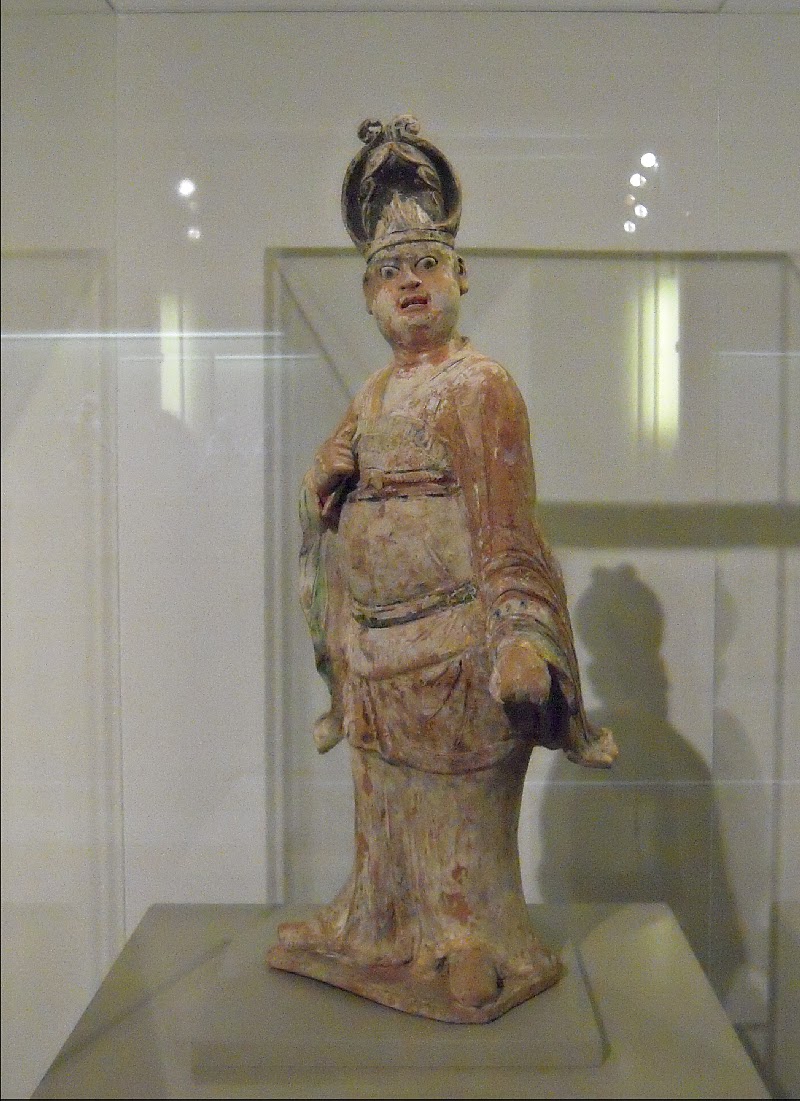
Il funzionario militare


Funzionario militare
Dinastia Tang, VIII secolo D.C.
Terracotta rossa, ingobbio bianco, pigmenti e oro
Military official
Tang Dinasty 8th centry A.D.
Red earthenware with white engobe, pigments and gold


Museo Arte Orientale, Torino

Monday, 18 April 2011

Neolithic China

One of the finest collection of neolithic artifacts outside of China is at MAO, Museo d'Arte Orientale, Via San Domenico 11, Torino. Here a movie showing some potteries. Here a movie showing the neolithic pottery (Firefox, Chrome)
.

Gandhara

Gandhāra is the name of an ancient kingdom in northern Pakistan and eastern Afghanistan. This Kingdom lasted from early 1st millennium BC to the 11th century AD. It attained its height from the 1st century to the 5th century under the Buddhist Kushan Kings. Gandhāra is known for the distinctive Gandhāra style of Buddhist art, which developed out of a merger of Greek, Syrian, Persian, and Indian artistic influence. This development began during the Parthian Period (50 BC – AD 75). Gandhāran style flourished and achieved its peak during the Kushan period, from the 1st to the 5th century. It declined and suffered destruction after invasion of the White Huns in the 5th century.
By the time Gandhara had been absorbed into the empire of Mahmud of Ghazni, around 1000 AD, Buddhist buildings were already in ruins and Gandhara art had been forgotten. In the 19th century, British soldiers and administrators started taking interest in the ancient history of the Indian Subcontinent. In the 1830s very old coins were discovered and decipherment of some Chinese records provided locations of Buddhists shrines. Along with the discovery of coins, these records provided necessary clues to piece together the history of Gandhara. In 1848 Gandhara sculptures have been discovered north of Peshawar. From then on a large number of Buddhist statues have been discovered in the Peshawar valley.


Headless Standing Buddha, II Century AD, Museo Arte orientale, Torino

Horse and dog - China


An animal sits on a pad behind the saddle.
Hunters can have a dog or a cheetah with them.

Tang Dinasty

China
Museo Arte Orientale, Torino

More on mounted hunters: Sport in the Golden Age of China, Lingyu Xie, Palmer Higgs Pty Ltd, Dec 3, 2013


Thursday, 27 January 2011

Museo in 3D


Dettaglio di una scultura indiana, da vedere in 3D con gli occhialini rosso/ciano.
Museo Arte Orientale