Confronto fra l'Ultima Cena della Cappella Marchionale di Revello ed il Cenacolo di Leonardo da Vinci
Résumé : La Cappella Marchionale di Revello ha una delle sue pareti affrescate con un'Ultima Cena chiaramente ispirata al Cenacolo di Leonardo da Vinci. L'articolo confronta e discute brevemente queste due opere. Dall'impostazione generale dell'affresco di Revello e dai diversi dettagli che in esso fanno riferimento al Cenacolo appare molto plausibile che l'artista aveva visto direttamente l'opera di Leonardo e non una riproduzione a stampa. Una curiosità: l'affresco di Revello mostra che nei piatti sulla tavola dell'Ultima Cena c'era del pesce. Proprio la presenza del pesce sulla tavola del capolavoro di Leonardo è stata proposta dai ricercatori che hanno restaurato il Cenacolo.
Wednesday, 20 September 2017
Tuesday, 19 September 2017
I vizi capitali ed i loro animali simbolici negli affreschi medievali di Villafranca Piemonte e di Bastia Mondovì delle Cavalcate dei Vizi
I vizi capitali ed i loro animali simbolici negli affreschi medievali di Villafranca Piemonte e di Bastia Mondovì delle Cavalcate dei Vizi: L'articolo discute un tipo particolare di rappresentazione simbolica dei vizi capitali. Questa rappresentazione è detta Cavalcata dei Vizi e mostra i personaggi posti sul dorso degli animali simbolo del vizio, legati dalla catena del peccato, e spinti dai diavoli verso la bocca dell'inferno. Le Cavalcate considerate nello specifico sono quella affrescata nella cappella di Missione di Villafranca Piemonte, opera tardo-medievale di Aimone Duce, e quella nella Chiesa di San Fiorenzo a Bastia Mondovì. Autrici: Lidia Dastrù, Amelia Carolina Sparavigna


Aimone Duce, Cavalcata dei vizi capitali, particolare. ca. 1430, affresco, Villafranca Piemonte
(Courtesy Laurom - Opera propria)

Friday, 25 August 2017
La pietra verde del Viso
Dice Piero Barale, nel suo articolo UN REBUS AI PIEDI DEL MONVISO che la valle Po, era già frequentata nel Neolitico dai “cercatori della pietra verde”, ossia di Pirosseni-Giadeite, "materiale litico di elevata durezza che veniva estratto nei depositi alluvionali della valle".
Più informazioni al sitohttps://sites.google.com/site/pietraverdedelviso/
Più informazioni al sitohttps://sites.google.com/site/pietraverdedelviso/
Saturday, 15 July 2017
Let in the Light: Ancient Roman Fort Designed for Celestial Show (Hardknott Roman Fort)
" The gateways of an ancient Roman fort in Britain are roughly aligned with the light from the sun during the summer and winter solstices — a design that would have resulted in a striking scene on the shortest and longest days of the year, a researcher says. ... " Let in the Light: Ancient Roman Fort Designed for Celestial Show


Hardknott Roman Fort
Friday, 3 March 2017
Thursday, 17 November 2016
A Minoan Geometry for Bisecting and Trisecting the Right Angle
A Minoan Geometry for Bisecting and Trisecting the Right Angle
https://papers.ssrn.com/sol3/papers.cfm?abstract_id=2754536
The faces of the Roman Emperors

The Appearance of Roman Emperors Rendered by a Face Detection Software
Here the discussion: https://papers.ssrn.com/sol3/papers.cfm?abstract_id=2773502
The Vesica Piscis of Sacred Geometry
The Vesica Piscis of Sacred Geometry

Here in the image the "Vesica Piscis" in the Bernini's Ovato of Saint Peter's Square
More in the articles:
A Mathematical Study of a Symbol: The Vesica Piscis of Sacred Geometry
Light and Shadows in Bernini's Oval of Saint Peter's Square
Flower of Life in the Mycenaean Geometry
The geometric decoration of some Mycenaean artifacts have a remarkable six-fold symmetry, probably suggested by the observation of the natural form of the honeycomb of beehives. Here a decoration of a gold roundel, made by means of a compass, that looks like the Flower of Life of sacred geometry.

For a detailed discussion, see please the article at the following link:
Wednesday, 16 November 2016
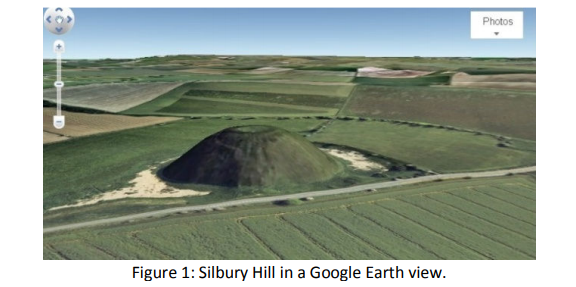
A possible role of Alpha Crucis in the astronomical landscape of Silbury Hill
Article https://papers.ssrn.com/sol3/papers.cfm?abstract_id=2795708 is discussing a possible link between the construction of Silbury Hill, the prehistoric artificial mound near Avebury, and the observation of Alpha Crucis, the main star of the Crux constellation, which was slowly disappearing from the local sky due to the precession of the Earth’s axis.
Monday, 13 June 2016
Sunday, 5 April 2015

Wednesday, 13 August 2014
A snake

The image, obtained from Google Maps, shows the network of earthworks separated by canals - near the Titicaca Lake. This is an ancient agricultural technique used by Andean people starting from the first millennium BC.

More on Titicaca
arXiv:1009.4602 [pdf] Geoglyphs of Titicaca as an ancient example of graphic design,
arXiv:1009.2231 [pdf] Symbolic landforms created by ancient earthworks near Lake Titicaca, Amelia Carolina Sparavigna
A.C. Sparavigna (2012)
Image Processing for the Enhancement of Satellite Imagery. In: Image Processing: Methods, Applications and Challenges / Vítor Hugo Carvalho. Nova Science Publishers, Inc. (USA), pp. 149-161. ISBN 9781620818442
A.C. Sparavigna, R. Marazzato (2011)
Using Geographic Information Systems to Increment the Knowledge of Cultural Landscapes. In: Smart Tech & Smart Innovation, La strada per costruire il futuro, Torino, 15-17 Novembre 2011.


A.C. Sparavigna (2010)
The geoglyphs of Titicaca. In: ARCHAEOGATE n. 13-10-. - ISSN 1973-2953


Saturday, 22 March 2014
The Pantheon as an astronomic instrument
Fiorenzo Laurelli (Twitter) published some interesting images on the sun in the Roman Pantheon.
In occasion of the Equinox he shows the light of the sun falling in this amazing temple. He is also providing an interesting reference of this subject: Il Pantheon come strumento astronomico, Fausto Masi, International EILES, 1996 .
Let us remember that the Pantheon is a building made of concrete. For more information on ancient concrete, see please my paper at the link http://www.ijsciences.com/pub/article/412
In occasion of the Equinox he shows the light of the sun falling in this amazing temple. He is also providing an interesting reference of this subject: Il Pantheon come strumento astronomico, Fausto Masi, International EILES, 1996 .
Let us remember that the Pantheon is a building made of concrete. For more information on ancient concrete, see please my paper at the link http://www.ijsciences.com/pub/article/412
Saturday, 1 February 2014
Faience: the ceramic technology of ancient Egypt
Faience: the ceramic technology of ancient Egypt - by Amelia Carolina Sparavigna, Archaeogate, 12-02-2012 ,
The term "faience" is commonly referred to a glazed earthenware, the use of which spread in Europe during the Renaissance from France and Italy [1]. The term was derived from Faenza, the town in Italy, where the glazed earthenware was mainly produced. The other name often used for this earthenware is "majolica". Majolica itself had a long tradition in the North African and Near East Islamic production of ceramic. In the 19th century, European archaeologists used the misleading name of "Egyptian faience" to designate the siliceous ceramics produced in the ancient Egypt. The ancient faience was a completely different material created to imitate the gloss and colour of gems and precious stones. This material started to be used in jewellery in Egypt and the Near East, about the fourth millennium BC [2], that is, during the predynastic age.
More at:
http://porto.polito.it/2489310/2/Faience_acs.pdf

At the Egyptian Museum, Torino
Subscribe to:
Posts (Atom)