"Joakim Wehlin of the University of Gothenburg and Gotland University has examined Bronze Age stone monuments that sit along Sweden’s Baltic Sea coasts. It had been thought that the monuments, which resemble stone ships, were used primarily as grave sites. Wehlin, however, thinks that they were used by maritime groups trading in metal objects. “It seems like the whole body was typically not buried in the ship, and some stone ships don’t even have graves in them. Instead, they sometimes show remains of other types of activities. So with the absence of the dead, the traces of the survivors tend to appear,” he explained. The monuments may have been used to mark ports, waterways leading inland, and potential meeting places." From http://www.archaeology.org/news/690-130322-sweden-stone-ships-bronze-age
https://sites.google.com/site/stoneships/
Tuesday, 21 May 2013

Saturday, 4 May 2013
Tuesday, 30 April 2013
Cesare e Cesarione
Quello sguardo amaro: i volti di Cesare e Cesarione. Intervista a Paolo Moreno
24/01/2011 - 12:44, di Giovanni Corazzi
Giusto un anno fa, nella nostra Umbrialeft veniva pubblicato un articolo in cui si parlava di una grande mostra, iniziata allora da qualche settimana (ottobre 2009) nel centro francese di Arles (presso il Musée départemental Arles antique) e dedicata agli oggetti riemersi dal fiume Rodano (riva destra, all’altezza, appunto, della cittadina provenzale) nel corso di una ventennale campagna condotta dal Drassm, il dipartimento ministeriale francese delle ricerche archeologiche, subacquee e sottomarine, guidato da Luc Long. .. tra cui un bellissimo busto. .. il Long sin dall’inizio avesse proposto senza esitazioni il nome di Cesare per il busto riemerso. Tale attribuzione, sebbene confermata da studiosi di valore quali lo storico Christian Goudineau (un classico il suo saggio su Cesare e la Gallia) e l’esperto di iconografia cesariana Flemming Johansen (autore di un importante lavoro del 1967, revisionato vent’anni dopo, dedicato ai ritratti in marmo di Cesare), è stata inizialmente contestata da altri studiosi, che hanno pensato a un magistrato romano o a un notabile di Arles. Fin dall’annuncio della scoperta (maggio 2008) era intervenuto al dibattito uno dei più importanti archeologi italiani, Paolo Moreno, ... Il Moreno ha toccato la questione anche nel 2009, con l’interessante ed elegante volume Cleopatra Capitolina (Editinera), e lo scorso ottobre in una lezione tenuta a Torino in occasione del «FestivalStoria». I suoi interventi hanno fornito nuove indicazioni sul ritratto, inserendolo in un ampio contesto che abbraccia il tratto mediterraneo da Arles ad Alessandria e che parla di una famiglia tanto grande quanto sfortunata. Divengono, infatti, protagonisti anche la regina d’Egitto Cleopatra e il figlio da lei avuto con Cesare, Tolemeo XV Cesare, meglio noto come Cesarione. Questi, nato nel 47 a.C., venne associato al regno a soli tre anni per volontà della madre, che evidentemente nutriva per il piccolo grandi progetti. ...
http://www.umbrialeft.it/approfondimenti/quello-sguardo-cos%C3%AC-amaro-volti-cesare-e-cesarione-intervista-paolo-mor
24/01/2011 - 12:44, di Giovanni Corazzi
Giusto un anno fa, nella nostra Umbrialeft veniva pubblicato un articolo in cui si parlava di una grande mostra, iniziata allora da qualche settimana (ottobre 2009) nel centro francese di Arles (presso il Musée départemental Arles antique) e dedicata agli oggetti riemersi dal fiume Rodano (riva destra, all’altezza, appunto, della cittadina provenzale) nel corso di una ventennale campagna condotta dal Drassm, il dipartimento ministeriale francese delle ricerche archeologiche, subacquee e sottomarine, guidato da Luc Long. .. tra cui un bellissimo busto. .. il Long sin dall’inizio avesse proposto senza esitazioni il nome di Cesare per il busto riemerso. Tale attribuzione, sebbene confermata da studiosi di valore quali lo storico Christian Goudineau (un classico il suo saggio su Cesare e la Gallia) e l’esperto di iconografia cesariana Flemming Johansen (autore di un importante lavoro del 1967, revisionato vent’anni dopo, dedicato ai ritratti in marmo di Cesare), è stata inizialmente contestata da altri studiosi, che hanno pensato a un magistrato romano o a un notabile di Arles. Fin dall’annuncio della scoperta (maggio 2008) era intervenuto al dibattito uno dei più importanti archeologi italiani, Paolo Moreno, ... Il Moreno ha toccato la questione anche nel 2009, con l’interessante ed elegante volume Cleopatra Capitolina (Editinera), e lo scorso ottobre in una lezione tenuta a Torino in occasione del «FestivalStoria». I suoi interventi hanno fornito nuove indicazioni sul ritratto, inserendolo in un ampio contesto che abbraccia il tratto mediterraneo da Arles ad Alessandria e che parla di una famiglia tanto grande quanto sfortunata. Divengono, infatti, protagonisti anche la regina d’Egitto Cleopatra e il figlio da lei avuto con Cesare, Tolemeo XV Cesare, meglio noto come Cesarione. Questi, nato nel 47 a.C., venne associato al regno a soli tre anni per volontà della madre, che evidentemente nutriva per il piccolo grandi progetti. ...
http://www.umbrialeft.it/approfondimenti/quello-sguardo-cos%C3%AC-amaro-volti-cesare-e-cesarione-intervista-paolo-mor

Saturday, 30 March 2013
The green stone
Suggested reading
Piero Barale, UN REBUS AI PIEDI DEL MONVISO RIFERIMENTI ASTRONOMICI
EMERSI DA ALCUNE INCISIONI RUPESTRI DELLE ALPI SUDOCCIDENTALI
The Po valley that, detaching from the Monviso, is the most important way to
get to this impressive mountain, had to favour different religious events as shown
by the still existing rock-engraving symbolizing the ancient people who pray.
These ancient cultural events have shown interesting astronomical
characteristics proving how the correlation between rock-engraving and the sky
observation during special periods of the year could be closed.
From the ideal centre from where the rock-engravings start, it seems it could be
possible to fix with great precision the changing of the seasons.
Furthermore, the users of this supposed “natural calendar” could get
information about the moon position during particular periods of its cycle;
situation that has always aroused great interest.
http://www.brera.unimi.it/sisfa/atti/1997/Barale.pdf
"La valle Po, già frequentata nel Neolitico20 dai “cercatori della pietra verde” -
(Pirosseni-Giadeite) materiale litico di elevata durezza che veniva estratto nei
depositi alluvionali della valle-, vedrà forse apparire le prime rappresentazioni
rupestri con la fine dell’età del Rame - inizio età del Bronzo. Ma con molta probabilità
il periodo di massimo sviluppo e popolarità del fenomeno si avrà solo
nell’età del Ferro. "
see also
http://stretchingtheboundaries.blogspot.it/2013/03/monte-viso.html
Piero Barale, UN REBUS AI PIEDI DEL MONVISO RIFERIMENTI ASTRONOMICI
EMERSI DA ALCUNE INCISIONI RUPESTRI DELLE ALPI SUDOCCIDENTALI
The Po valley that, detaching from the Monviso, is the most important way to
get to this impressive mountain, had to favour different religious events as shown
by the still existing rock-engraving symbolizing the ancient people who pray.
These ancient cultural events have shown interesting astronomical
characteristics proving how the correlation between rock-engraving and the sky
observation during special periods of the year could be closed.
From the ideal centre from where the rock-engravings start, it seems it could be
possible to fix with great precision the changing of the seasons.
Furthermore, the users of this supposed “natural calendar” could get
information about the moon position during particular periods of its cycle;
situation that has always aroused great interest.
http://www.brera.unimi.it/sisfa/atti/1997/Barale.pdf
"La valle Po, già frequentata nel Neolitico20 dai “cercatori della pietra verde” -
(Pirosseni-Giadeite) materiale litico di elevata durezza che veniva estratto nei
depositi alluvionali della valle-, vedrà forse apparire le prime rappresentazioni
rupestri con la fine dell’età del Rame - inizio età del Bronzo. Ma con molta probabilità
il periodo di massimo sviluppo e popolarità del fenomeno si avrà solo
nell’età del Ferro. "
see also
http://stretchingtheboundaries.blogspot.it/2013/03/monte-viso.html
"Monte Viso is the location of a neolithic jadeite quarry, at an elevation of 2000 to 2400 metres. Its productivity peaked around 5000 BC. The jadeite was used to make cult axes, which are found all over western Europe." From Wiki
Geheimnisvolle Kult-Beile: Statussymbole der Steinzeit, Von Almut Bick
Sie sind ein Mysterium, eines der größten Rätsel aus der Zeit der Jäger und Sammler: Steinklingen aus kostbarstem Jadeit. Wozu dienten diese Äxte, die Archäologen in halb Europa gefunden haben? Forscher sind dem Geheimnis nun dicht auf der Spur ...Über sechstausend Jahre ist es her, dass die steinzeitlichen Bergleute mit dem äußerst seltenen Jadeit heimkehrten. Hoch oben, jenseits der Schneegrenze des Monte Viso in den italienischen Alpen, betrieben sie einen regelrechten Steinbruch für das grüne Mineral. ...
http://www.spiegel.de/wissenschaft/mensch/geheimnisvolle-kult-beile-statussymbole-der-steinzeit-a-477917.html
See also:
Zwischen Atlantik und Schwarzem Meer , Die großen Beile aus alpinem Jadeit im 5. und 4.Jt. v. Chr
by Serge Cassen
http://www.academia.edu/1954923/Zwischen_Atlantik_und_Schwarzem_Meer_Die_grossen_Beile_aus_alpinem_Jadeit_im_5._und_4.Jt._v.Chr
Zu den Jadeit-Quellen am Monte Viso
by Rengert Elburg
http://www.academia.edu/3119319/Zu_den_Jadeit-Quellen_am_Monte_Viso
Geheimnisvolle Kult-Beile: Statussymbole der Steinzeit, Von Almut Bick
Sie sind ein Mysterium, eines der größten Rätsel aus der Zeit der Jäger und Sammler: Steinklingen aus kostbarstem Jadeit. Wozu dienten diese Äxte, die Archäologen in halb Europa gefunden haben? Forscher sind dem Geheimnis nun dicht auf der Spur ...Über sechstausend Jahre ist es her, dass die steinzeitlichen Bergleute mit dem äußerst seltenen Jadeit heimkehrten. Hoch oben, jenseits der Schneegrenze des Monte Viso in den italienischen Alpen, betrieben sie einen regelrechten Steinbruch für das grüne Mineral. ...
http://www.spiegel.de/wissenschaft/mensch/geheimnisvolle-kult-beile-statussymbole-der-steinzeit-a-477917.html
See also:
Zwischen Atlantik und Schwarzem Meer , Die großen Beile aus alpinem Jadeit im 5. und 4.Jt. v. Chr
by Serge Cassen
http://www.academia.edu/1954923/Zwischen_Atlantik_und_Schwarzem_Meer_Die_grossen_Beile_aus_alpinem_Jadeit_im_5._und_4.Jt._v.Chr
Zu den Jadeit-Quellen am Monte Viso
by Rengert Elburg
http://www.academia.edu/3119319/Zu_den_Jadeit-Quellen_am_Monte_Viso
Sunday, 3 March 2013

Thursday, 21 February 2013
Neolithic mounds of Tassili and Amguid
Today I read this beautiful article, entitled, ALGERIA, ”TASSILI n’AJJER”, Viaggio effettuato dal 01 al 10 Novembre 2001, By Davide Bergami e Antonella Bergonzoni, Posted Saturday, November 19, 2005 on
http://www.sahara.it/bm/saharaThree/viaggi/resoconti/algeria-tassili-najjer.shtml

More about this at
http://www.sahara.it/bm/saharaThree/viaggi/resoconti/algeria-tassili-najjer.shtml
Among the images the authors are showing of the travel there is the picture of a Neolithic mound, a "key-hole" tomb. Here a partial reproduction of their image

Algeria was populated since 10,000 BCE, as shown by several archaeological sites located in the Tassili National Park. Very important are there the engravings and cave paintings, dated between 8000 and 4000 BCE, where people of Neolithic age depicted animals such as elephants and hippopotami, showing that once the climate was rather different and far wetter than it is today.
The Tassili n'Ajjer is a vast plateau in south-east of Algeria. In Berber its name means the Plateau of the Rivers. This plateau is composed mainly of sandstone. Because of the water-holding properties of the sandstone, the vegetation here is somewhat richer than in the surrounding desert. In fact, the name "Plateau of the rivers" seems to echo that period of time, known as the Neolithic Subpluvial or Holocene Wet Phase, when the climate of Maghreb was wet. It was a period preceded and followed by drier periods, the most recent of some wet climatic conditions of the Sahara, named "Green Sahara", during which the region supported a rich vegetation, animals and humans.
The Tassili n'Ajjer is a vast plateau in south-east of Algeria. In Berber its name means the Plateau of the Rivers. This plateau is composed mainly of sandstone. Because of the water-holding properties of the sandstone, the vegetation here is somewhat richer than in the surrounding desert. In fact, the name "Plateau of the rivers" seems to echo that period of time, known as the Neolithic Subpluvial or Holocene Wet Phase, when the climate of Maghreb was wet. It was a period preceded and followed by drier periods, the most recent of some wet climatic conditions of the Sahara, named "Green Sahara", during which the region supported a rich vegetation, animals and humans.
Some Neolithic mounds, built by the ancient populations that lived in what once was a "Green Sahara", are visible in the satellite images of Google Maps. In particular, due to a high enough resolution, we can see some of the mounds of the regions of Tassili and Amguid in Algeria.
More about this at
Neolithic mounds of Tassili and Amguid in the satellite Google Maps
Monday, 10 December 2012
Dimensions for making a replica Roman dodecahedron (1)
Let us suppose somebody wants to make a replica of a Roman dodecahedron,
here a recipe. Consider the following image
here a recipe. Consider the following image

Centered at the center of each face, draw a circle, which will be a hole. These circles usually have different diameters. Print and cut the image.
If you want some figures, you can, for instance use the article at the following link:
http://www.scribd.com/doc/116123429/The-Roman-Dodecahedron-of-Kadath
Here I am reproducing a table.
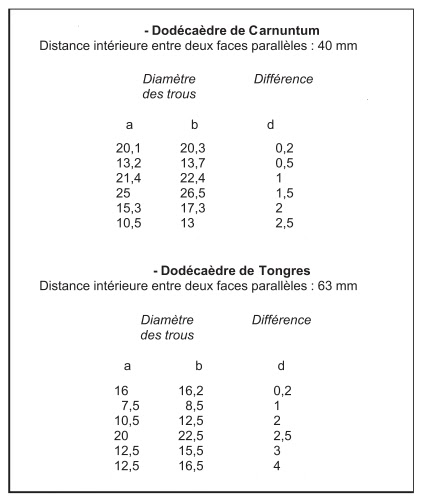
Here we have not the exact potions of the holes, but we have the diameters of hole on the opposite faces.
According to the image of the dodecahedron, 1 is opposite 12, 2 opposite 11, 3 opposite 10, etc.

Tuesday, 16 October 2012
"Carved stone balls from Scotland are an enigmatic class of objects. They date to the late Neolithic or early Bronze Age, between 3200 and 1500 BC, and are made of various stones ranging from sandstone to granite. They ... are decorated with carved evenly-spaced patterns of circular bosses or knobs around the surface of the sphere. The designs vary with the majority being based around a series of six bosses, but the number of bosses varies from 3-160."
More at http://www.ashmolean.org/ash/britarch/highlights/stone-balls.html

More at http://www.ashmolean.org/ash/britarch/highlights/stone-balls.html

Saturday, 22 September 2012
When America discovered Europe
A very remarkable book this one
The American discovery of Europe, By Jack D. Forbes
Let me suggest the reading of it. To stimulate the curiosity, here some small abstracts
The American discovery of Europe, By Jack D. Forbes
Let me suggest the reading of it. To stimulate the curiosity, here some small abstracts
What is Cornelius Nepos telling? And Pliny?


Wednesday, 15 August 2012
Empresa destruye patrimonio cultural
Empresa destruye patrimonio cultural
"El observatorio más antiguo de América, es afectado por trabajos de empresa autorizada por el INC. Desconocen informes que dan cuenta de restos arqueológicos alrededor de área patrimonial."
"El observatorio más antiguo de América, es afectado por trabajos de empresa autorizada por el INC. Desconocen informes que dan cuenta de restos arqueológicos alrededor de área patrimonial."
Ancient solar observatories: Syrian desert
The Syrian desert is covered by ancient stone structures created during Neolithic times, as I discussed in the paper, Stone circles on the harraat of Syrian desert, published at http://arxiv.org/abs/1106.4665
Some of these stone structures are circular, with radial lines of stones. These circles have been also compared with Stonehenge. Therefore, we can ask ourselves, are these solar observatories too, as Stonehenge is.
The answer is probably so, see my paper at http://arxiv.org/abs/1208.2591
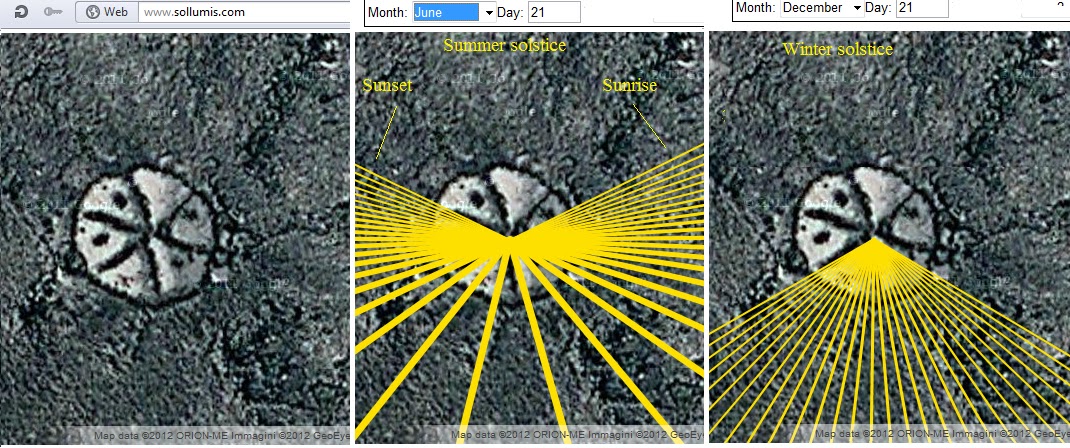
I used a software for the solar energy applications to see the direction of sun on sunrise and sunset of solstice. It seems that there is a good agreement. Therefore, the Syrian stone circles are probably the Stonehenges of Middle East.
 This is one of the stone structure of Syrian Desert. The image shows directions of sun during the day. “The lines on the drawing show the direction and height (altitude) of the sun throughout the day. Thicker and shorter lines mean the sun is higher in the sky. Longer and thinner lines mean the sun is closer to the horizon”, according to Sollumis.com http://www.sollumis.com/. On the left, the site as it appears in the Google Maps. In the middle, the direction of the sun on the summer solstice, choosing the center of the circle for observation. We see that, at sunrise, the sun is passing near the dot. At the sunset the direction is that of a line. In the image on the right, we see the direction of the sun on winter solstice. At sunrise, the lines is passing between dots. The sunset has the direction of a radius (images have been obtained from original provided by Google Maps and sollumis.com).

Some of these stone structures are circular, with radial lines of stones. These circles have been also compared with Stonehenge. Therefore, we can ask ourselves, are these solar observatories too, as Stonehenge is.
The answer is probably so, see my paper at http://arxiv.org/abs/1208.2591
I used a software for the solar energy applications to see the direction of sun on sunrise and sunset of solstice. It seems that there is a good agreement. Therefore, the Syrian stone circles are probably the Stonehenges of Middle East.

Circles and lines!
Alignemnt at the sunrise on the winter solstice
At the site http://www.dp-news.com/en/detail.aspx?articleid=97188
it is told that "He (David Kennedy) explains that they come in a huge variety of forms, some being ‘kites’, structures that funnelled animals, some being seemingly random meandering lines of stone and others being rectangular. None are believed to be aligned with the stars, which has added to the mystery surrounding their purpose." Well, in my opinion it is not so.
Alignemnt at the sunrise on the winter solstice
At the site http://www.dp-news.com/en/detail.aspx?articleid=97188
it is told that "He (David Kennedy) explains that they come in a huge variety of forms, some being ‘kites’, structures that funnelled animals, some being seemingly random meandering lines of stone and others being rectangular. None are believed to be aligned with the stars, which has added to the mystery surrounding their purpose." Well, in my opinion it is not so.
Tuesday, 24 July 2012
Roman jewelry in Japan
TOKYO —"Glass jewelry believed to have been made by Roman craftsmen has been found in an ancient tomb in Japan, researchers said Friday, in a sign the empire’s influence may have reached the edge of Asia."
http://www.japantoday.com/category/national/view/roman-jewelry-found-in-ancient-tomb-near-kyoto
http://www.japantoday.com/category/national/view/roman-jewelry-found-in-ancient-tomb-near-kyoto
20,000 years old pottery in a Chinese cave
"BEIJING (AP) - Pottery fragments found in a south China cave have been confirmed to be 20,000 years old, making them the oldest known pottery in the world, archaeologists say."
New Jersey Herald - Pottery 20,000 years old found in a Chinese cave
New Jersey Herald - Pottery 20,000 years old found in a Chinese cave
Subscribe to:
Posts (Atom)